
The 8 Month Sleep Regression: Signs, Length and What Helps
Posted
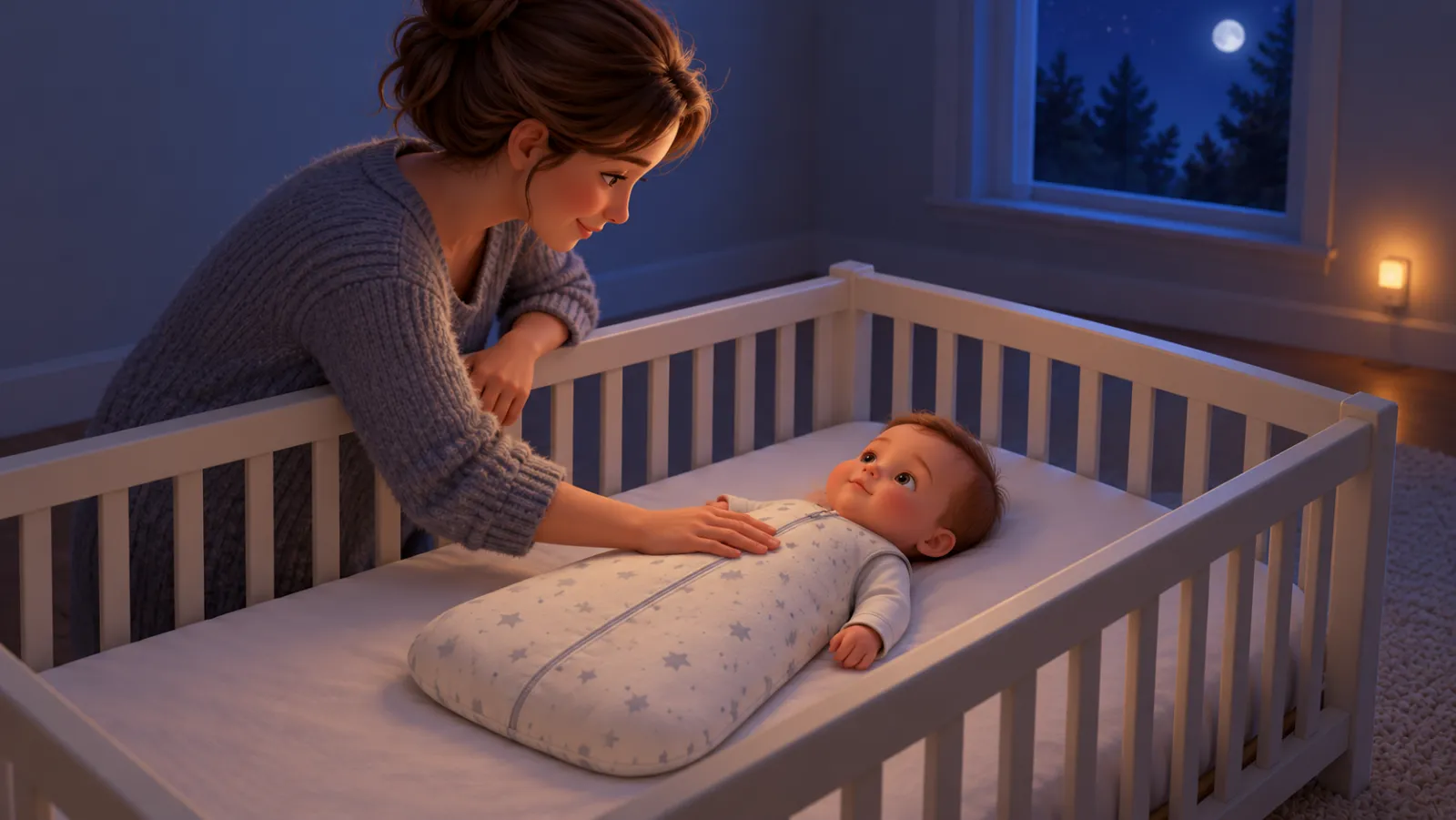
Your 8 month old was sleeping. Now they wake at 1am, stand up in the cot, and cry the moment you leave the room. Most parents call this the 8 month sleep regression. It is usually the sleep cost of everything your baby is learning right now, and it passes.
Key Takeaways
- Parents often report anything from a few days to a few weeks, but no study has measured how long a sleep regression lasts.
- Common signs are more night waking, short naps, bedtime resistance, and a baby who practises crawling or standing in the cot.
- Common triggers are new movement skills, separation anxiety, teething, and a schedule that no longer fits.
- The changes that help most are a short repeatable wind-down, a wake window that suits your baby today, and an earlier bedtime after a bad nap day.
What Is the 8 Month Sleep Regression?
The 8 month sleep regression is a patch of broken sleep in a baby who had been settling well, usually somewhere between 7 and 10 months. It is not a medical diagnosis and nothing has gone backwards.
The 4 month sleep regression is tied to a lasting change in how your baby's sleep cycles work. The 8 month one comes from several developmental changes that overlap, so sleep can get lighter and more broken while your baby works through them.
8 Month Sleep Regression Signs
You are probably in it if several of these started at once:
- Waking more often overnight after previously doing longer stretches.
- Taking longer to settle at naps or bedtime.
- Suddenly resisting being put down in the cot.
- Short naps, or naps that feel less predictable.
- Crying more when you leave the room.
- Pulling up, crawling, rocking, or sitting in the cot instead of lying down.
- Early morning waking.
- More clinginess in the evening.
How Long Does the 8 Month Sleep Regression Last?
Parents often report anything from a few days to a few weeks, but no study has measured how long a sleep regression lasts. For some babies the rough patch is over in under a week. For others it comes and goes for longer while a new skill, a schedule change, or a phase of separation anxiety settles.
If the broken sleep drags on with no sign of improving, or you are struggling to cope, speak to your health visitor. The NHS suggests this for any baby who is having problems sleeping, and you do not have to wait it out alone.
Why Is My 8 Month Old Not Sleeping?
There is rarely one reason. An 8 month old who is not sleeping is usually dealing with a few things at once.
New movement skills
Babies usually start crawling, or bottom shuffling instead, at around 7 to 10 months. Some are also starting to pull themselves up on furniture and on cot bars. A baby who has just worked out how to move will practise everywhere, including at 2am in the dark.
Separation anxiety
Separation anxiety is when your baby gets upset at being apart from you. The NHS says it is common in children between 6 months and 3 years, and the American Academy of Pediatrics says most babies develop it more strongly at around 9 months.
At bedtime that looks like more tears when you put your baby down, and waking to check that you are still nearby. It is a sign your baby knows exactly who you are. You have not created a bad habit.
Teething
The NHS lists being more fretful than usual and not sleeping very well among teething symptoms, so sore gums can add to a bad week. Teething is easy to blame for everything, though. If your baby seems in pain, feverish, or unwell, get them checked rather than assuming it is teeth.
A schedule that no longer fits
A wake window is the time your baby is awake between sleeps. These windows get longer through the second half of the first year, so a routine that worked at 6 months can start producing short naps and bedtime battles.
Some babies are also still settling after the move from three naps to two, especially if sleep had already become difficult during the 6 month sleep regression.
8 Month Wake Windows
Most 8 month olds do well with roughly 2 to 3.5 hours of awake time between sleeps, usually across two naps.
Wake Window Chart By Age
Suggested wake-window starting ranges from 1 to 12 months
Use this as a practical starting point, then adjust for your baby's cues, feeding patterns, and how naps are actually going.
| Age | Suggested starting range | Guide |
|---|---|---|
| 1 month | 30-90 min (30 min to 1 h 30 min) | |
| 2 month | 45-105 min (45 min to 1 h 45 min) | |
| 3 month | 75-120 min (1 h 15 min to 2 h) | |
| 4 month | 90-150 min (1 h 30 min to 2 h 30 min) | |
| 5 month | 90-150 min (1 h 30 min to 2 h 30 min) | |
| 6 month | 120-180 min (2 h to 3 h) | |
| 7 month | 120-210 min (2 h to 3 h 30 min) | |
| 8 month | 120-210 min (2 h to 3 h 30 min) | |
| 9 month | 160-210 min (2 h 40 min to 3 h 30 min) | |
| 10 month | 180-210 min (3 h to 3 h 30 min) | |
| 11 month | 180-225 min (3 h to 3 h 45 min) | |
| 12 month | 195-240 min (3 h 15 min to 4 h) |
Selected age
8 month old
120-210 min
That usually works out to about 2 h to 3 h 30 min of awake time before the next nap or bedtime as a starting point.
If your baby starts fighting naps, taking very short naps, or seems wide awake at the usual time, they may be ready for a small adjustment.
8-month old guideTreat these ranges as a starting point rather than a target. A baby who slept badly overnight often needs a shorter first window, and the longest window of the day is usually the one before bed. For a fuller explanation, see our guide to wake windows.
What Helps During the 8 Month Sleep Regression
Keep the wind-down short and the same
A calm, predictable wind-down lowers stimulation and gives your baby familiar signals that sleep is coming. The order matters more than the length. Bath, nappy, sleeping bag, feed, story, cot, in that order every night, does more than a long routine that changes.
Respond the same way every time
Consistency matters more than picking the perfect method. A response that changes from night to night makes bedtime harder to predict, which is the opposite of what an anxious baby needs. Choose a calm response you can repeat at 3am on no sleep, and stick with it for a couple of weeks before you judge it.
Handle standing in the cot without turning it into a game
Give your baby plenty of floor time in the day to practise crawling, pulling up, and sitting back down. The skill gets less exciting once it is easy. At night, help them down quietly, say the same short phrase, and leave. Keep it dull: chatting, laughing or play at night can turn standing up into a game.
The Lullaby Trust advises placing your baby on their back for every sleep, day and night. Once your baby can move from their back to their front and back again by themselves, they can find their own sleeping position, so you do not need to get up all night to reposition them.
Rebuild the day after a bad nap
One bad nap can throw the whole day off. Rather than forcing the original plan, shorten the next wake window. If the second nap was awful, an earlier bedtime usually helps more than stretching your baby through an overtired evening.
Keep the room dark and the background noise steady
A dark room and consistent white noise reduce the things that can wake a lighter sleeper. Our guide on why white noise and red light help baby sleep covers how to use both.
When to Speak to Your GP or Health Visitor
Most 8 month sleep regressions are developmental. Ask for help when:
- Your baby is refusing feeds or taking much less than usual.
- They have fewer wet nappies than expected.
- They seem in pain, feverish, or generally unwell.
- You are worried about breathing, snoring, or unusual sounds in sleep.
- The lack of sleep is seriously affecting your mental health or ability to cope.
Frequently Asked Questions
Is the 8 month sleep regression real?
Yes, in the sense that the broken sleep is real and common. It is not a formal diagnosis, but it is a useful name for a patch of disrupted sleep linked to development, schedule changes, and stronger attachment behaviours.
Does every baby have an 8 month sleep regression?
No. Some babies barely seem affected and others have a very obvious rough patch. A lot depends on temperament, routine, sleep needs, and what else is happening developmentally.
Why is my 8 month old not sleeping unless I am there?
That often points to separation anxiety, which is common at this age. Your baby is more aware of your absence than they used to be and needs extra reassurance while that settles.
What are normal 8 month wake windows?
Many 8 month olds do well with roughly 2 to 3.5 hours of awake time between sleeps, usually across two naps.
Can I use an earlier bedtime if naps were awful?
Yes. An earlier bedtime is usually more helpful than stretching your baby through a very overtired evening.
Related Reading
- 4 month sleep regression
- 6 month sleep regression
- 3 to 2 nap transition
- Wake windows explained
- Tips to help your baby sleep
- Why white noise and red light help baby sleep
This article is general information and not medical advice. If you have concerns about your baby's health, feeding, development, or sleep, speak to your health visitor, GP, or paediatrician.